Architecture Levels
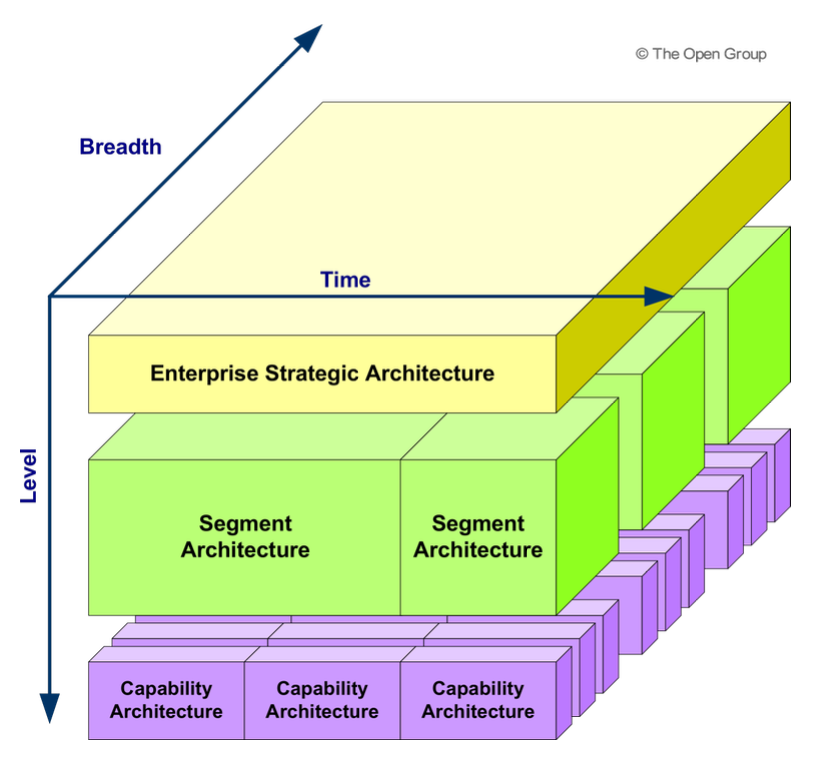
Levels provide a framework for dividing the Architecture Landscape into three levels of granularity:
- Strategic Architecture provides an organising framework for operational and change activity and allows for direction setting at an executive level.
- Segment Architecture provides an organising framework for operational and change activity and allows for direction setting and the development of effective Architecture Roadmaps at a program or portfolio level.
- Capability Architecture provides an organising framework for change activity and the development of effective Architecture Roadmaps realising capability increments.
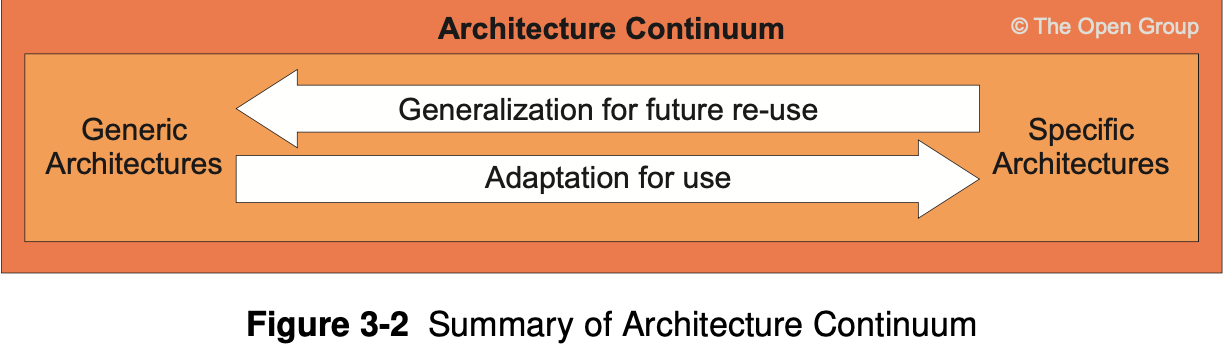
The Architecture Continuum provides a method of dividing each level of the Architecture Landscape by abstraction. It offers a consistent way to define and understand the generic rules, representations, and relationships in an architecture, including traceability and derivation relationships. The Architecture Continuum shows the relationships from foundation elements to organisation-specific architecture, as shown in Figure 3-2.
The Architecture Continuum is a useful tool to discover commonality and eliminate unnecessary redundancy.
Levels and the Architecture Continuum provide a comprehensive mechanism to describe and classify the Architecture Landscape. These concepts can be used to organise the Architecture Landscape into a set of related architectures with:
- Manageable complexity for each individual architecture or solution
- Defined groupings
- Defined hierarchies and navigation structures
- Appropriate processes, roles, and responsibilities attached to each grouping
There is no definitive organising model for architecture, as each enterprise should adopt a model that reflects its own operating model.